
Have you ever walked into your small living room and felt like everything is off—disorganized, stuffy, and not as beautiful as you imagined?
I’ve experienced that feeling too. But with a few intentional changes, I discovered that even a small living room can feel luxurious, functional, and welcoming.
Here are five simple formulas that transformed my space—and can transform yours too.
1. Prioritize Functional Beauty
If your living room is small, every item you bring in must serve a purpose.
Before buying furniture, ask yourself:
- Will this item be useful?
- Does it serve more than one function?
- Also, think about who the space is for:
If it’s just for you, a single comfortable sofa with a soft rug may be enough
If you host visitors, arrange seating to encourage conversation
For example, a beautiful sofa set with hidden storage is a smart choice.
It provides comfort while also giving you space to store documents and accessories—keeping your room neat and clutter-free.
When beauty meets function, your space becomes both elegant and practical.
2. Master the “Floating” Arrangement
Many people push furniture against the wall, thinking it creates space—but it actually makes the room feel boxed in and smaller.
- Pull your sofas slightly away from the wall
- Arrange them to “float” within the space
This creates:
- Better visual balance
- A more open and breathable layout
Also, follow the pathway rule: Make sure there is a clear path for movement. A stylish room allows you to walk freely without squeezing through furniture.
Space is not just about size—it’s about how you arrange it.
3. Establish a Clear Focal Point
Every beautiful living room has a center of attention.
This could be:
- A large window
- A piece of wall art
- A well-designed TV area
The focal point helps guide your arrangement. Instead of placing furniture randomly, everything is positioned around this central feature.For example: If your focal point is wall art, your sofas should face it
A focal point brings order and purpose to your design.
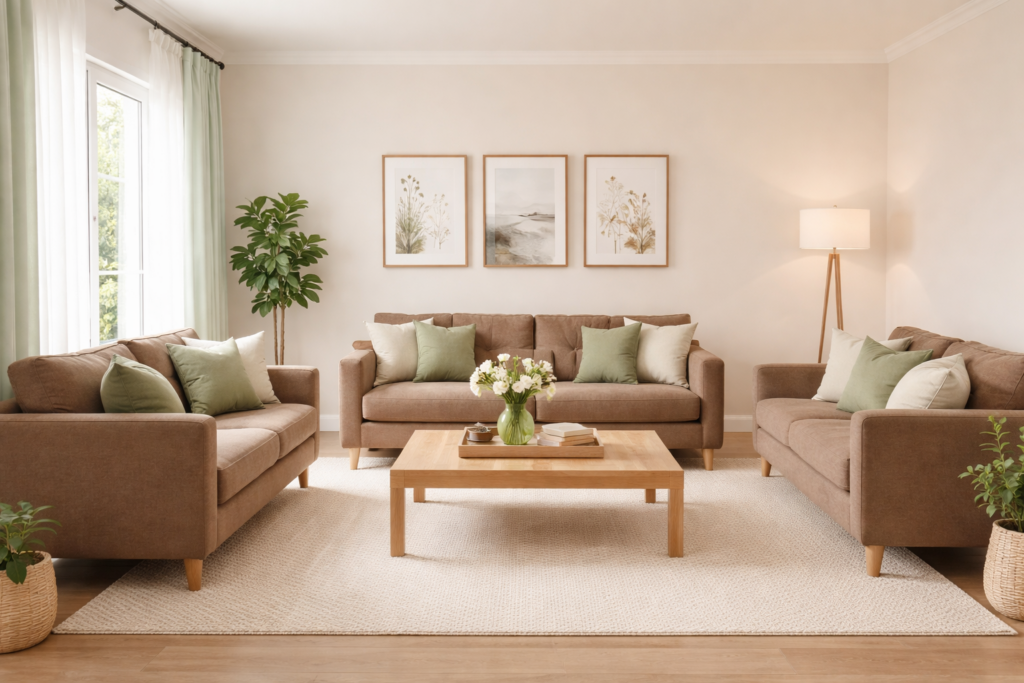
4. Use the 60-30-10 Rule and Create Rhythm
To achieve a balanced and professional look, use the 60-30-10 color rule:
- 60% (Main color): warm neutral tones (walls, main furniture)
- 30% (Secondary color): supporting tones (curtains, rugs)
- 10% (Accent color): bold touches (pillows, decor items)
But don’t just place colors—repeat them.
This creates rhythm, which makes your room feel connected.
For example:
- A green pillow can match a green vase
- A wooden table can match wooden frames
This repetition guides the eye smoothly, making your space feel complete and expensive.
5. Master Scale, Proportion, and Height
A common mistake is thinking small rooms need small furniture. That’s not true.
What matters is proportion.
- Choose furniture that fits your space—not too big, not too tiny
- Use one large rug instead of many small ones to anchor the seating area
Also, create vertical rhythm by varying heights:
- A tall lamp
- A medium indoor plant
- A low coffee table
This high–medium–low arrangement draws the eye upward, making the ceiling feel higher and the room more spacious.
Good proportions create comfort, while height variation creates eleganc
A small living room doesn’t have to feel limited. With the right approach, it can become a calm, stylish, and inviting sanctuary.
It’s not about having more—it’s about choosing better, arranging wisely, and designing with intention.